Death is everywhere. It shapes our communities, our laws, our healthcare system, our religions, our environment, our culture and, eventually, every single one of us.
For more than a decade, journalism and independent media have played a critical role in helping the death positive movement grow, giving people language for experiences they haven’t known how to talk about, introducing them to possibilities they didn’t know existed, and helping turn individual questions into collective conversations which have led to actual change in the deathcare landscape.
Enter GraveSite, a new death-focused media platform launching this week. Founded by journalists Delaney Rebernik and her co-founder, Alexis Haut, after years of working in mainstream and legacy media, GraveSite is setting out to treat death as the expansive beat it actually is, covering science, law, culture, belief, policy, and the business of deathcare, alongside the deeply personal experiences of dying and grieving.
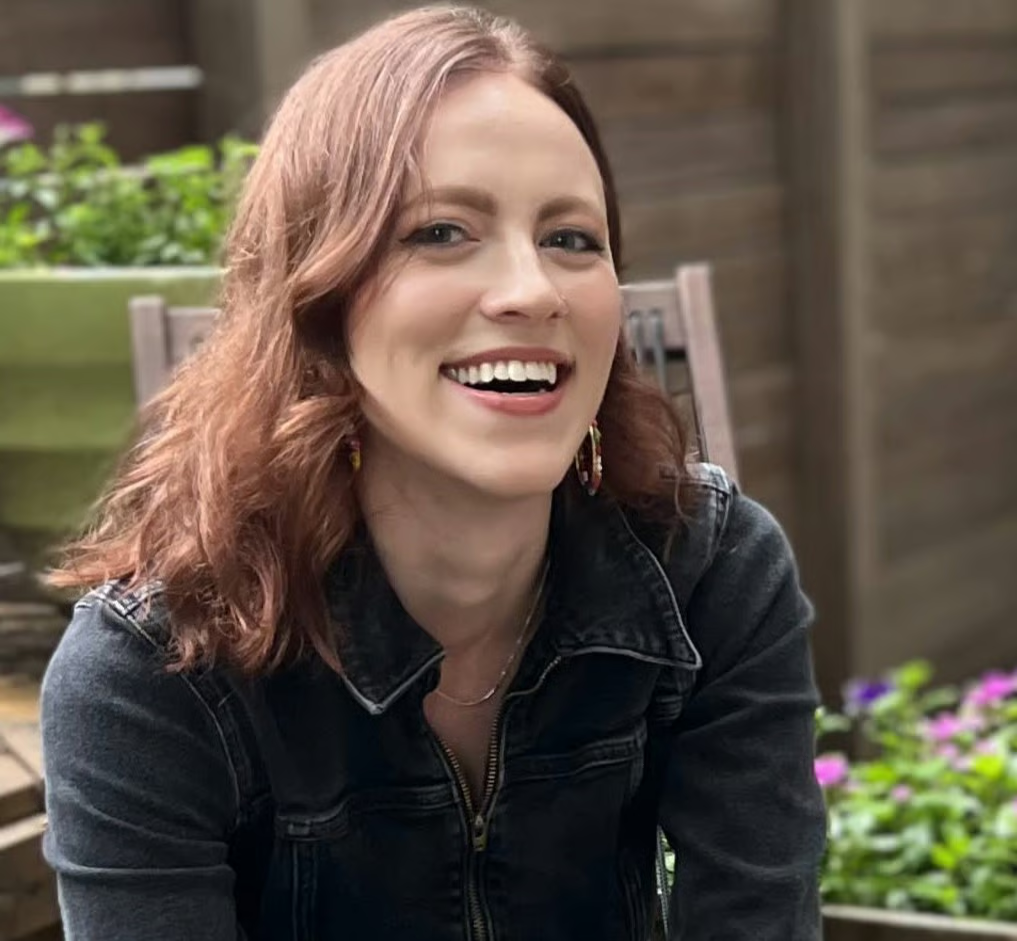
To mark GraveSite’s launch, we sat down with founder and editor-in-chief Delaney Rebernik to talk about why she decided death needed its own beat, what mainstream media gets wrong about covering mortality, who GraveSite is for, and why sometimes the best response to the absurdity of being alive is to laugh.
Sarah Chavez: You and your co-founder have published work in outlets ranging from Bloomberg and Fortune to TIME and the Guardian. After building careers in mainstream and legacy media, what made you decide that death deserved a publication of its own?
Delaney Rebernik: I started writing about death when my dad died in December 2022, which was a surprisingly intuitive jump from my previous focus on healthcare. For my first reported essay on the subject — exploring the persisting guilt in my grief for the fantastic online magazine Psyche — I interviewed some of the preeminent grief psychologists here in the U.S. and abroad, like Dr. Robert Neimeyer of the Portland Institute for Loss and Transition, and it opened my eyes to this whole new world full of people who’d channeled their profound losses into something profoundly meaningful for the collective.
I was even more moved by the outpouring of gratitude and personal stories I received in response to the piece. Paragraphs and paragraphs of pain and care and catharsis came by email and phone and social media, in conversation with my account of being someone alive and imperfect who’d been forced into the bewildering new position of loving someone dead and imperfect. The stories came from strangers and friends and family and family of friends and — most moving of all — from some older loved ones who’d never before broached the subject of their own life-changing losses with me. It was all so powerful. And I thought, maybe I have an opportunity here to bridge my lived experience, which was and continues to be painful, with my professional skillset. So death became my beat.
And then my mom died suddenly last December of last year, and I went from, “that’s going to be my beat,” to, “screw it, we need an outlet for this.” I’d been independent for three years at that point, been in media and editorial product development my entire career, and been tracking the journalism-led democratic newsroom movement. I thought that my experience in the business aspects of media, plus the editorial aspects, would position me well to lead a publication like this, and so I started talking to some of my peers in the space running national outlets focused on a specific niche, like big tech or repro and gender rights. And I thought, death comes for us all, and there are all these thorny systemic and cultural issues here in the U.S. surrounding who gets a good death, so we need dedicated coverage. I was kind of shocked that something like GraveSite didn’t already exist. Multiple journalists and deathcare workers have told me they wish they’d thought of it. So now we’re jazzed to have them as collaborators and advisors.
SC: You could likely continue placing stories at major national outlets. What freedoms does building GraveSite give you as editors and storytellers that other publications often can’t offer?
DR: I’ve been reporting on death for years at this point for legacy outlets like Time and the Guardian, as well as journals with large readerships of mental and digital health professionals, and I’ve had great experiences. But one thing I’ve noticed is the limited space mainstream pubs have for death coverage. During editing, I’m often pulled maybe two levels up from where I wanted to go, which is down this rabbit hole of reaching the best experts in different areas — science, medicine, law, philosophy — to provide the value and perspective I wish I’d had as someone not only grieving, but also dealing with the excruciating logistics of death here in the U.S. Navigating two separate probate courts at once is no joke.
And that’s when I even get commissioned. Lots of editors have turned me down altogether even after acknowledging the significance of the coverage I’m proposing. One piece in particular stands out, about Dr. Neimeyer, who I referenced earlier, and his new research into grief attacks. Before a fantastic editor at Time commissioned it, I’d gotten feedback from multiple outlets, including one dedicated to mental health and psychology specifically, saying, “This is a little too sad; it’s the holidays.” It was mid-December. My dad died December 19, and my mom died three years later on the 28th. So, here I am being like, “No, this is important, and this is the time people are going to have these grief attacks if they’re going to have them.”
Some incredibly accomplished reporters we’ve commissioned told me they’ve had similar pushback from the big pubs on their death pitches. When I announced GraveSite on LinkedIn, one even wrote “Journalists on the ‘death beat’ are rejoicing at this news!” which was really heartening. So our goal is to fill this huge gap in coverage — seriously, only 110 media and communications workers cover the country’s $20B deathcare industry — with reporting that goes deeper, and is more unflinching, to be useful to people in the throes of death and grief in a society that’s often allergic to the reality of our mortality.
So, Gravesite’s mission — we say this in various ways in various places — it’s to make us less weird about death, so we can live better in the meantime. That’s really what we’re trying to do. My priority is to be ruthlessly helpful to people.
SC: How would you describe GraveSite’s mission?
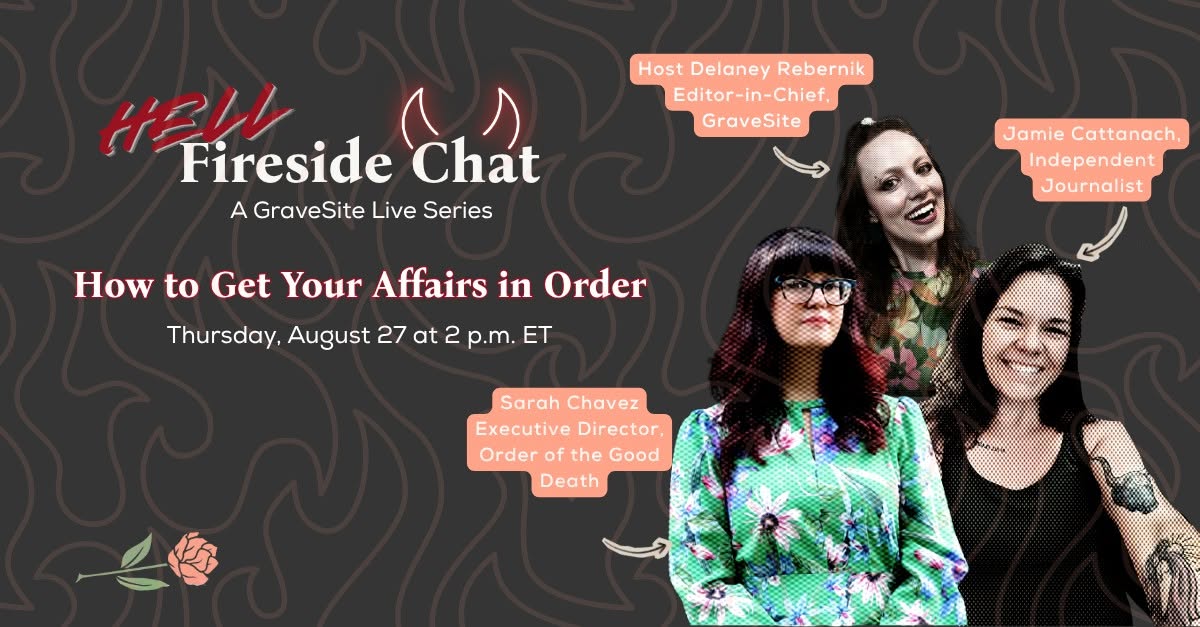
DR: My big ambition is for GraveSite to become the publication of record on death in the U.S. For some people, maybe they grab a practical guide on how to get their affairs in order, which is the first thing we put out (and which The Order’s own Sarah Chavez graciously contributed to!). I had several historically death-avoidant loved ones turn up to our first fireside chat on the subject, which just about melted my heart. And then we have other folks who’ve signed up as founding members, which is really powerful in helping sustain us.
So, Gravesite’s mission — we say this in various ways in various places — it’s to make us less weird about death, so we can live better in the meantime. That’s really what we’re trying to do. My priority is to be ruthlessly helpful to people. The question that underpins everything we put out is: Will this be significantly helpful to a significant number of people?
Our focus right now is the U.S., because there’s a huge regulatory and policy element that shapes and scales people’s experiences of deaths and all the inequities and things that come with that. And at the same time, we’ve already commissioned stories that speak to more novel, overlooked, or far-flung experiences. But all that to say, we’re really interested in being of service to people navigating a really complex, fraught system here, and filling a real gap that we see in journalism in that way.
SC: What feels different about the cultural conversation around death in 2026 compared to say, five years ago?
DR: The biggie is the pandemic and how, societally, we likely won’t know for a while all the ramifications of that period. As of July 2023, there have been over 1.1 million deaths from COVID-19 in the U.S., and for every one of those deaths, nine people on average are bereaved, so our collective grappling continues on. And it’s made harder by the fact that Western death culture — and we’ve published on this too — can be a lot more avoidant than some other cultures.
But we’re seeing signals that Americans are becoming more open. In a 2023 report to HHS, grief researchers said that the pandemic “reduced stigma and encouraged discussions about loss and grief.” And I’ve reported on the increasingly widespread and thoughtful treatment of death in shows like The Pitt opening conversations between loved ones.
Then, of course, there’s all the devastating political work at play — deaths in ICE custody or resulting from stripped back reproductive rights — and thorny policy issues around disruptive deathtech and medical aid in dying. People are confronting tremendous losses at scale through all these forces, and they’re tired of pretending to be okay.
SC: Who do you imagine as your core readership and what do you hope surprises them most about the stories you’re telling?
DR: As I said, we’re primarily focused on the U.S. for now, so Americans, though much of our coverage of beliefs, culture, and science will have broader appeal. But when you say everyone, it means no one, so what we’ve seen so far among our earliest supporters is a throughline of recent loss, which a big chunk of us can relate to right now. A recent pre-pandemic study found about a third of Americans have lost someone close to them in the past three years, and a fifth have lost a pet. COVID-19 has only exacerbated this loss.
So the mourners are our most impassioned supporters right now, as are folks who’ve dedicated their careers to improving deathcare — the funeral directors, the doulas, the clinicians, the good-death activists, and the body-disposition entrepreneurs. Selfishly, I do also want to lure my fellow freaks who like horror as much as I do, or like to explore death in capacities beyond grief, while leaving room for people blessed with less of a stomach for death talk.
SC: Reporting on death can mean covering everything from the funeral industry to climate change, religion, medicine, crime, and culture. How do you decide what belongs under the GraveSite umbrella? What kinds of stories are most likely to make you say, “Yes, this is exactly why we started this!”?
DR: I love reporting or writing that centers someone who’s actively wrestling with some aspect of death. I have a journalist working right now on a piece on their experience, soup-to-nuts, planning their water cremation, which involves the relational work of getting a skeptical loved one on board and all the logistical implications of navigating an emerging disposition method. So I like to engage a subject — who may or may not be the writer — at the point of their journey where they have real insight and perspective but haven’t fully processed out of all the stickiness.
I’m really interested, too, in belief — it’s one of our core pillars. I’m agnostic, and the less religious I’ve become over time, the more appreciative I am of the ways spirituality and religion can imbue death, mortality, and life with meaning. And so I’m excited to commission pieces on unexpected and surprising spiritual practices, religious beliefs that have maybe been buried through various historical forces.
I also have big ambitions — that I’ll need to bring in some big guns for — to turn our power vertical into a vehicle for investigative journalism on deathcare in the U.S., and the exploitation that can be rife in an industry that comes into someone’s life at a time when they’re perhaps their most vulnerable. So I’m really interested in seeing that expand as we grow and gain readership.
Finally, I love to laugh. That’s one of the best things I’m carrying forward from my parents. And for me, humor has been a saving grace in grief. So I don’t think everything has to be all doom and gloom. There’s real space for Gravesite to be playful — we’ve recruited an incredible author and grief educator with a wicked sense of humor as our advice columnist — and to be philosophical and galaxy-minded about the future, and to be irreverent about some of the more outlandish (im)mortality views people are peddling. Sometimes you just gotta laugh at the absurdity of being alive and knowing that one day you won’t be.