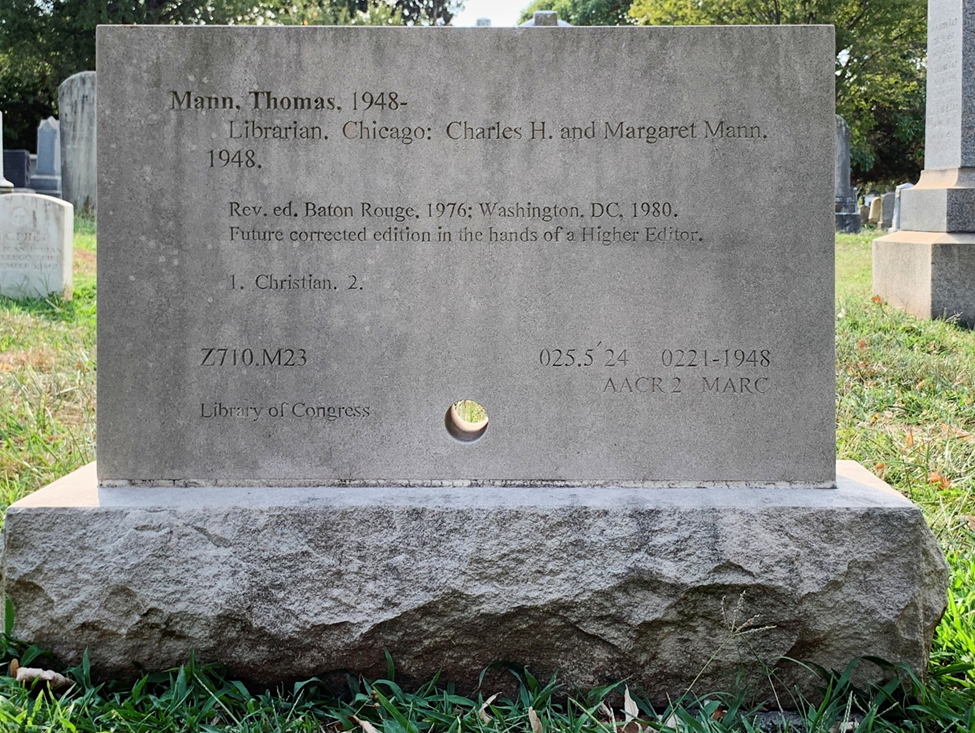
Libraries and archives – like the stone and bronze statues that we might traditionally categorize as monuments and memorials – are sites where memories are preserved, honoured, altered, or even deliberately removed. Their role in the creation and retention of individual, cultural, and collective memory makes them also prone to being sites of loss or grief, and other types of monuments also often are. Considering these spaces as monuments – as sites of and for memory work – invites us to acknowledge not only the preservation work they perform but also the various ways that grief can be experienced and processed within them or embedded within their walls stacks, operations, and events.
Pierre Nora defines lieux de mémoire (sites of memory) as inherently contradictory – both simple and ambiguous, natural and artificial, concrete and abstract. They emerge from an intentional will to remember and are at once material, functional, and symbolic, shaped by the complex interplay between memory and history. These sites exist, Nora argues, because milieu, (real environments) of memory have disappeared: the lived, social, and uninterrupted memory of an event or tradition has vanished, leaving behind fragmented and mediated historical representations. But milieux de mémoire do not simply disappear; they fade away as the individuals who retain them pass away, meaning that sites of memory are inextricably tied to death. As Kinsley and Stothert-Maurer have noted, ‘Because records pass to archives when they have reached the end of their life in their primary function, death and loss are often the contexts in which they are transferred.’ It is in the passage from life to death that one’s memory environments have the potential to transition to sites of memory.
Libraries and archives are ideal and quite literal sites of memory in that they function as sites where the material fragments of real memory environments may be collected, preserved, and transformed into historical evidence. In addition to the objects archivists seek out for their collections, individuals may seek out opportunities to write themselves into history. ‘Donors seek out archives for a variety of reasons, including the promise of a permanent home for materials, the desire to honour a loved one, or the wish to have material included in the archival record’ (Kinsley and Stothert-Maurer, 2024). But more than just preserving memory, these locales are symbolic sites that conjure abstract notions of community, identity, and culture. In this respect, libraries and archives concurrently function as real environments of memory within which such abstract notions may be formed through real experiences before becoming the stuff of history.
Public understanding of libraries and archives often go hand in hand; indeed, librarians and archivists often receive parallel training, and archives are often housed within libraries. Additionally, libraries and archives both serve communities through the preservation and transmission of knowledge. While both may be understood as milieux and lieux de mémoire in these ways, their roles diverge subtly albeit importantly. Drawing on the work of cultural and collective memory theorists Aleida Assmann, Jan Assmann, Maurice Halbwachs, and others, a useful point of departure is to consider how libraries and archives function within their respective cultural landscapes.
Jan Assmann distinguishes between communicative memory – short-term, interpersonal memories transmitted within living social networks – and cultural memory: a formalized, temporally distanced, narrative supported by institutions. Whereas communicative memory is organic, informal, and embedded in everyday life, cultural memory emerges when these lived experiences are codified and preserved beyond their original context. Cultural memory manifests in material and institutional forms such as written records, monuments and memorials, rituals and holidays, curricula, and, indeed, libraries and archives. Yet libraries and archives do not simply preserve cultural memory; they engage dynamically with both communicative and cultural memory in an ongoing cycle of generation, transmission, and preservation. The lived experiences of various actors within these spaces can and have become historical records. Libraries, in particular, function as vital sites of communicative memory. As community centres, they foster social connections by hosting lectures, exhibitions, cultural gatherings, and support groups or offering community access to technology, services, and even temporary shelter. Far more than repositories of books, libraries are spaces of living memory where knowledge, culture, and the present are continuously activated.