Home> Learn> Articles> What Happens When Death Walks Into the Classroom?
What Happens When Death Walks Into the Classroom?
A professor finds that teaching death and dying opens the door to difficult questions, challenged assumptions, and unexpected conversations about faith, meaning, and what it means to live.
Teaching about death and dying is not for the faint of heart.
The topic itself and course headings such as assisted dying and questions of suicide were enough to offer students a sense of hesitation, if not outright objection. When I first began teaching this course in Spring of 2025, I was not sure what to expect of its reception and popularity. After all, the last time that the class had been taught at the college where I teach had been in 2023 and it was discontinued due to the retirement of the professor who had taught it for years. I was also aware that the class would have to be structured in a way that would fulfill the mission of the school while offering a range of cultural perspectives regarding ritual, meaning, and afterlife depictions.
American Baptist College is a small HBCU that is dedicated to preparing students for Christian leadership and social justice in a wide variety of fields. Many of its graduates move on to divinity schools and become active preachers, educators and political activists. Due to this background and demographic, any class on death and dying would be required to have a theological component. After discussing the course with my academic dean, I decided to take on an approach that would combine theology, philosophy, and an overview of topics covered in contemporary death studies scholarship.
We covered a lot in the first several weeks: discussions on Christian eschatology, Buddhism, cultural, new religious movements and indigenous religions started the course off with a number of ideas that challenged student expectations. The Buddhist notions of impermanence and emptiness sharply contrasted with traditional Christian thought with its reliance upon eternal truths and firmly delineated answers about the afterlife. Being able to shift mentalities to understand, if not agree, with subject matter that builds off an alien foundation is a key skill that philosophical education can foster. Students initially did not embrace having their religious beliefs confronted, with a few stating outright that they were not used to critically examining their own religious training. Although this could have led to some conflict, these same students also acknowledged that analysing their beliefs was part of taking a humanities course and was necessary to truly understand the course material.
Leading into philosophical discussion with Plato’s Phaedo, the class pushed through talk of Nietzsche’s eternal return and death of God, Camus’ analysis of Sisyphus and the immanence of death in culture/history. I was expecting the, at times, controversial topics covered in this section to be an issue for the students; talking about the death of God raised the ire of several students. After some extensive conversation though, the class began to understand that Nietzsche’s polemic, in all of its exuberance and force, speaks more of the corruption of religious sentiment than the physical death of God. The class saw the value and meaning in critically examining their religious ideals and they were able to see the nuance that is necessary for approaching questions of mortality.
Sisyphus by Jeffrey Hummel
As we moved deeper into the field of death studies, we began to explore how the field and its social sciences emphasis relates to real world case studies and controversies ranging from assisted dying to abortion and the death penalty. Contemporary death studies, also known as thanatology in the United States, is an interdisciplinary academic field that examines the biological, psychological, sociological, and cultural aspects of death, dying, and bereavement. It focuses on improving end-of-life care, understanding the grieving process, and exploring human attitudes toward mortality. It is the more formal, academic exploration of the same questions and interests that the Order of the Good Death approaches from a multitude of different angles.
The majority of scholarship done in this field takes place overseas, with many organizations being found in the UK. The Association for the Study of Death and Society, based at the University of York, is one group that brings together a diverse international community of researchers, professionals and interested parties through a range of supportive initiatives and activities. Located at the University of Bath, The Centre for Death & Society takes a similar anthropological view of the natural processes of death and dying; both organizations host a number of workshops, conferences and online events that helps to bring together an international base of scholars.
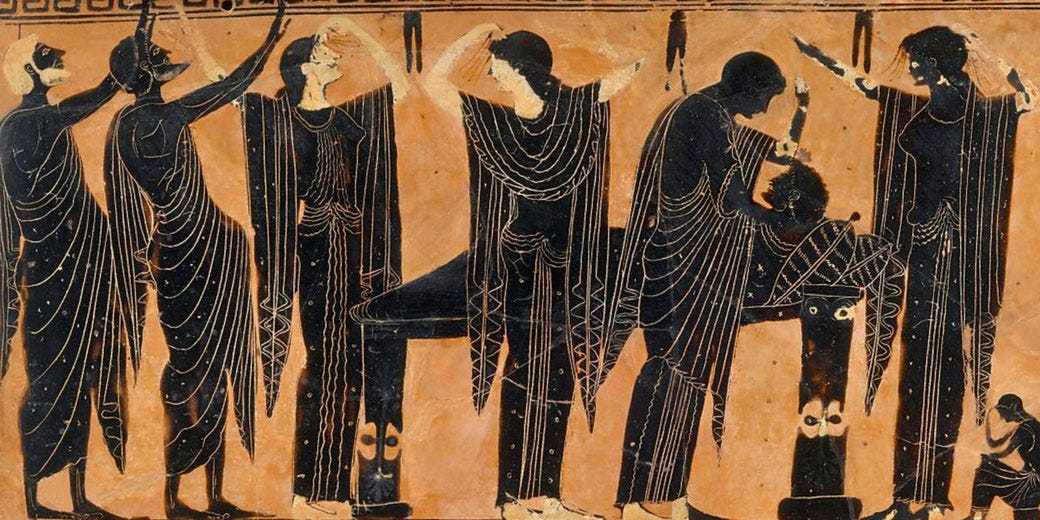
The lying in state of a body attended by family members, with the women ritually tearing their hair, depicted on a terracotta pinax by the Gela Painter, latter 6th century BC.
The number of groups dedicated to exploring the themes of death and dying were powerful reminders to my students that multicultural perspectives on the topic deserve some measure of respect and should be understood on their own merits. As the class came to learn about difficult cultural death rituals, afterlife beliefs and grieving practices, their empathic responses grew; several discussions led to deep reflection, emotional outpourings and a sharing of connective moments that are not ordinarily found in the classroom. During one session, we watched a documentary called The Suicide Plan, which explores the right to die movement with detailed case studies of specific organizations and their methods for helping people to die on their own terms. The stories shared in this documentary struck a nerve; several students talked about how they wish they knew of these options when watching their loved ones die. Others were conflicted because they could see the value of having these death options, but were trying to reconcile that value with their religious ideals. Class ended early that night with the tearful testimony of one student who spoke candidly about how the course materials, especially the work of Jessica Mittford, resonated with her past work in healthcare and the families who she had counseled through end of life conversations.
Despite the initial reservations that some students had, several approached me at the end of the semester to share the impact that the class had with them. I was honored to learn that, for many of these students, the unexpected nature of the course materials and the novelty of the subject matter made the class their favorite for the semester. Some of these comments came through in daily journal entries and an assignment where they had to write an elegy for a loved one or for an immaterial part of their life that they had grieved or was lost to them somehow. What I have gained from my two semesters leading this class is a renewed confirmation that the topic of death and dying is important and meaningful, especially when it is first approached with a bit of skepticism. Knowing that my students were hesitant and still pushed to engage with the material was a testament to their own ability and desire to challenge themselves to grow in the pursuit of knowledge. Death and dying is a complex field of study and adding the weight of theology/philosophy only heightens the difficulty of approaching it in a manner that retains the humanistic aspect of the topic, but also makes it appropriate for academic study. Death studies embodies the concept of memento mori, and it is a privilege to work within this space.
Robert Spinelli is the archivist for Special Collections at Middle Tennessee State University.