Image via The Spectacle of Illusion, published by D.A.P. Wellcome Library, London.
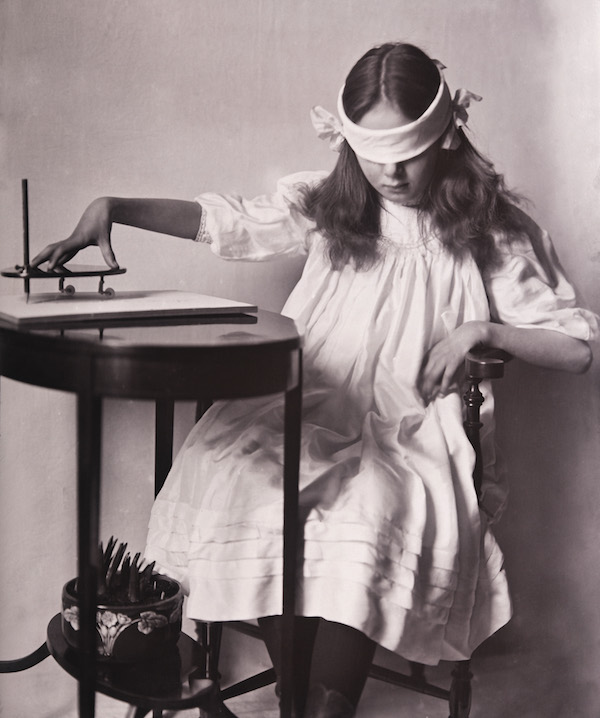
A young girl operating a planchette.
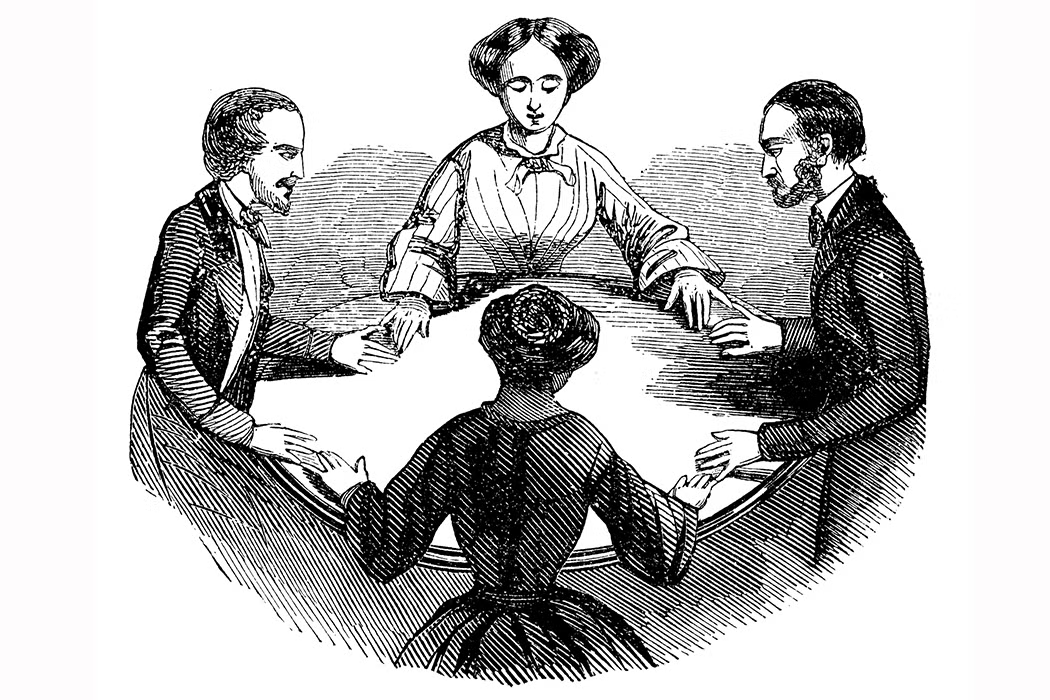
Throughout American history, where are women in the public spaces? I don’t mean that in some fancy academic sense. Literally, where are the women? In America, there are over five thousand roads named for George Washington, which makes sense; as a Founding Father and the first president, he is a big deal. There are significantly fewer named for notable women. You can ask Google Maps, but it will probably not tell you to take the Rosa Parks Expressway to the Ruth Bader Ginsburg Exit and then merge onto the Dolly Parton Turnpike. In New York City you can sit in traffic on the Hutchinson River Parkway, biding your time, singing along to the radio, and cursing the SUV in front of you. Named for Anne Hutchinson, a preacher deemed “heretical” by the Massachusetts Bay Colony and exiled to an area north of Manhattan (now the Boogie Down Bronx), the road itself meanders by the stream where she and her family were killed by Indigenous people who were at war with the Dutch colonizers. But that’s about it. And while we’re still asking for our proverbial place at the table, a number of mediums would at least help women emerge from literal obscurity and into the spotlight.
For several enterprising women, the platforms movement would provide both comfort and the tools necessary to forge their own roads into politics, finance, and other spheres of influence. The spirits would lead them to the offices of the most powerful men in America and set a new standard for women as pundits, counselors, and celebrities. Not that the timing for that leap was perfect–in fact, it was pretty awful. In the run-up to the Civil War, the experts on both sides were convinced that the country was going to heck in a handbasket and that the silly women (and their duped male counter-parts) talking to spirits were not helping matters. Additionally, because Spiritualism was associated with the radical notions of aboli-tion and suffrage, it was an easy target for critics in both North and South. An 1859 women’s rights convention in Buffalo was described by a syndicated column in the papers as a public nuisance.
The Convention of self-styled reformers has been sitting in this city for two days past, comprising the leading abolitionists, spiritualists, free-lovers, infidels, fanatics, and women’s rights men and women of the country. They have been assiduously searching for the origin of evil and its cure, while their speeches, for the most part, have been disgusting and blasphemous. The Convention closes its session tomorrow (Sunday), and the publicgenerally will experience a feeling of relief when the city is rid of these reformers.
This seems harsh, but to be fair, any large gathering of progres-sive women is still viewed in some corners of this country as unladylike, hysterical, and potentially dangerous. Don’t forget the panic of the “pussyhat” era when a peaceful mass turnout of women struck fear into the hearts of men such as former Arkansas governor Mike Huckabee, who said that “the Women’s March on Washington in protest of Donald Trump’s presidency was a ‘vulgar’ and ‘sexist’ display by leftists who seemed more like members of a religious cult than legitimate demonstrators.”
One of Spiritualism’s deepest impacts on America was its insistence that women be heard in the halls of power, even if it equivocated on who was actually speaking. While the movement’s numbers were growing, its connection with both radical causes and female leadership made it a somewhat threatening and discrediting association for men in power. To add to Lincoln’s other troubles during the Civil War, accusations were lodged against him that not only was he a warmonger and race traitor, but he was also a “spirit rapper.” According to the anonymous pamphleteer who went by the pen name “A Citizen of Ohio,” we were a “A Nation Demonized,” and Spiritualism was at the dark heart of it. This citizen argued passionately that the rappings and table turnings of the years leading up to secession made the nation vulnerable to war, and Lincoln, the big dope, had fallen under Spiritualism’s spell.
The war, which is upon us, these spirits have induced, by preparing the minds of men for its inauguration, and now, through a president and his adviser, whom they control, they are hurrying the country on to its destruction…Mr. Lincoln is not only a Spiritualist of the abolitionist school, but has his media around him, and has been from the beginning of his term directing the war under the direction of spirit rapping.
Before there was the “lost cause” myth, there was the “lost souls” gambit. The cause of the Civil War is, was, and will always be slavery. That said (and it still sadly seems to need saying), at the time, by aligning Lincoln with Spiritualists, his enemies could make him look like a weak, henpecked, and even insane leader.
However, because the Union won and he tragically died a martyr, you can also make any cause look better by associating it with Honest Abe. The image of Lincoln, almost more than his actual words and deeds, remains something of a totem for every generation that has come since. Permanent but mutable, he’s reinterpreted on all sides to stand for the promise of self-made American ambition and “the better angels of our nature,” particularly in pop culture, where almost every generation gets the cinematic Lincoln that they deserve. Movies from Birth of a Nation to Spielberg’s Lincoln tend to cast him as something of a down-to-earth deity who appears in troubled times to broker peace and comity—or kill the occasional zombie or vampire, as needed. To claim a piece of Lincoln’s image is to place oneself at the center of America’s history, zeitgeist, and mythology.
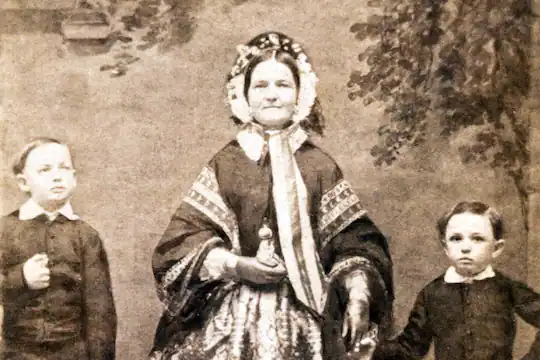
Given all that, it’s no small wonder Spiritualistts claimed him as one of their own, even if he wasn’t really one of their number. It’s more likely that his wife, Mary Todd Lincoln, was seeking out its comforts, so he was around for it, if not hunting down a personal experience. Plus, given the amount of loss that life had thrown the Lincolns’ way, you could understand their desire the reach across the veil. By 1863, Mary had already buried two of her four sons: Edward, who was taken from them by tuberculosis at four years of age, and twelve-year-old Willie, who was lost to typhoid fever just the year before. The latter of which was so devas-tating to her that she was unable to attend his funeral or move from her bed for three weeks. Willie was also said to be reaching back. According to medium Fanny Conant’s 1873 autobiography, the Lincolns’ child came through during her regular cirr circles in the Boston area. According to her recollections, “Among the spirits who regularly controlled the medium at this place was the little spirit son of the then president of the United States. By him, through the mediumistic organization of Mrs. C., the reelection of his father to the Presidency, and his subsequent tragical death at the hand of an assassin were also correctly predicted.” Mary Todd Lincoln’s own image also has changed somewhat over the years, from a grief-mad spendthrift to someone suffering with genuine loss and mental illness. Modern medical historians have postulated that she may have suffered from everything from bipolar disorder to pernicious anemia both compounded by head injuries from a carriage accident. Whatever the root cause, Mary was not handling her grief with the stoicism expected of a first lady.
Wikimedia Commons
Mary Lincoln with two of her four sons, Willie and Tad, in 1860.
The need to relieve her unshakable sorrow was probably what brought mediums like Fanny Conant, Nettie Colburn Maynard, and others into the First Lady’s orbit. While it is possible that Abe attended one or more of the circles Mrs. Lincoln held in the Red Parlor, there are no definitive writings from him on the subject, so his level of interest and involvement in those readings depends on whom you ask. Colburn Maynard was instrumental in build-ing part of this mythology. In the medium’s telling of it, Abe hung on every word; historians are a bit more circumspect about the influence of the spirits. Whatever the truth of his innermost thoughts, in America any association with Lincoln could always prove useful in spreading your message. Colburn Maynard’s 1891 memoir entitled Was Abraham Lincoln a Spiritualist? (spoiler alert: the answer is a resounding yes) provides one such account. In particular, an impromptu reading at the White House would turn into an opportunity for the spirits to change the course of history. Describing her trance that night, she said, “For more than an hour I was made to talk to him, and I learned from my friends that it was upon matters that he seemed fully to understand, while they comprehended very little until that portion was reached that related to the forthcoming Emancipation Proclamation.” Further the spirits advised Lincoln that he “must stand firm in his convictions and fearlessly perform the work and fulfill the mission for which he had been raised up by overruling providence.” To be clear, Colburn Maynard makes the distinction that it was not her (a silly young women) advising the president; it was the sage spirit of a man of accomplishment. “Those present declared that they lost sight of the timid girl in the majesty of the utterance, the strength and force of the language and what was said the importance of what was was conveyed and seemed to realize that some strong masculine spirit force was giving speech to almost divine command.” This scene represents a snapshot of the doors that Spiritualism opened to some women. It created proximity to power but draped it in the layers of demure modesty that the era required. Women’s ambition had to be some sort of discretely shared secret.
What Colburn Maynard and Conant were doing was revolutionary—in a quiet way. They were inserting themselves into the narrative of history and power; they were normalizing the presence of women as advisers and experts (albeit in a roundabout fashion) to male decision-makers. They couldn’t vote, they couldn’t hold property in most cases, but here they were suggesting that they could be believed and considered in matters of the utmost importance to the nation, not merely as conduits for the dead and consolers of the bereaved. To state their importance and declare their access—even if it was indirect—was a way of developing and standardizing a new form of soft power.
Excerpt from When We Spoke to the Dead: How Ghosts Gave American Women Their Voice by Ilise S. Carter and reprinted with permission courtesy of Sourcebooks. Copyright Sourcebooks 2025. Purchase copies here.
Ilise S. Carter is a freelance writer and performer based in New York City. Her first book, The Red Menace: How Lipstick Changed the Face of American History from Prometheus Books has been called “one of the most fascinating fashion histories I’ve ever read” by Harper’s. As her award-winning stage persona, The Lady Aye, she has worked as sideshow performer with acts ranging from Rob Zombie to Cirque du Soleil and has appeared on Gossip Girl, Oddities, The President Show, Mysteries at the Museum, and Dickinson.