Home> Learn> Articles> Three Astonishing Take Aways from the American Funeral Preferences Survey
Three Astonishing Take Aways from the American Funeral Preferences Survey
Some of the 2025 survey results confirm what people in the funeral reform space have been saying for years. Some of the results shocked even us. Here are three key take aways.
At the Order of the Good Death, we care about your future corpse. We care about helping you accept your death, deciding what you want done with your eventual dead body, and then achieving that choice legally, financially, and logistically.
So when, in 2024, Professor Tanya Marsh of Wake Forest Law School asked to partner with the Order to develop questions for an annual survey to document trends in American funeral preferences, we were thrilled. This would be the largest survey of its kind EVER conducted, asking 1,500 Americans from all ages, races, geographic locations, and religions on what they want done with their dead bodies. The results from the past two years are fascinating, and the idea is to run the survey every year to confirm the data and document trends.
Some of the 2025 survey results confirm what people in the funeral reform space have been saying for years. Some of the results shocked even us. Let’s talk about three key take aways.
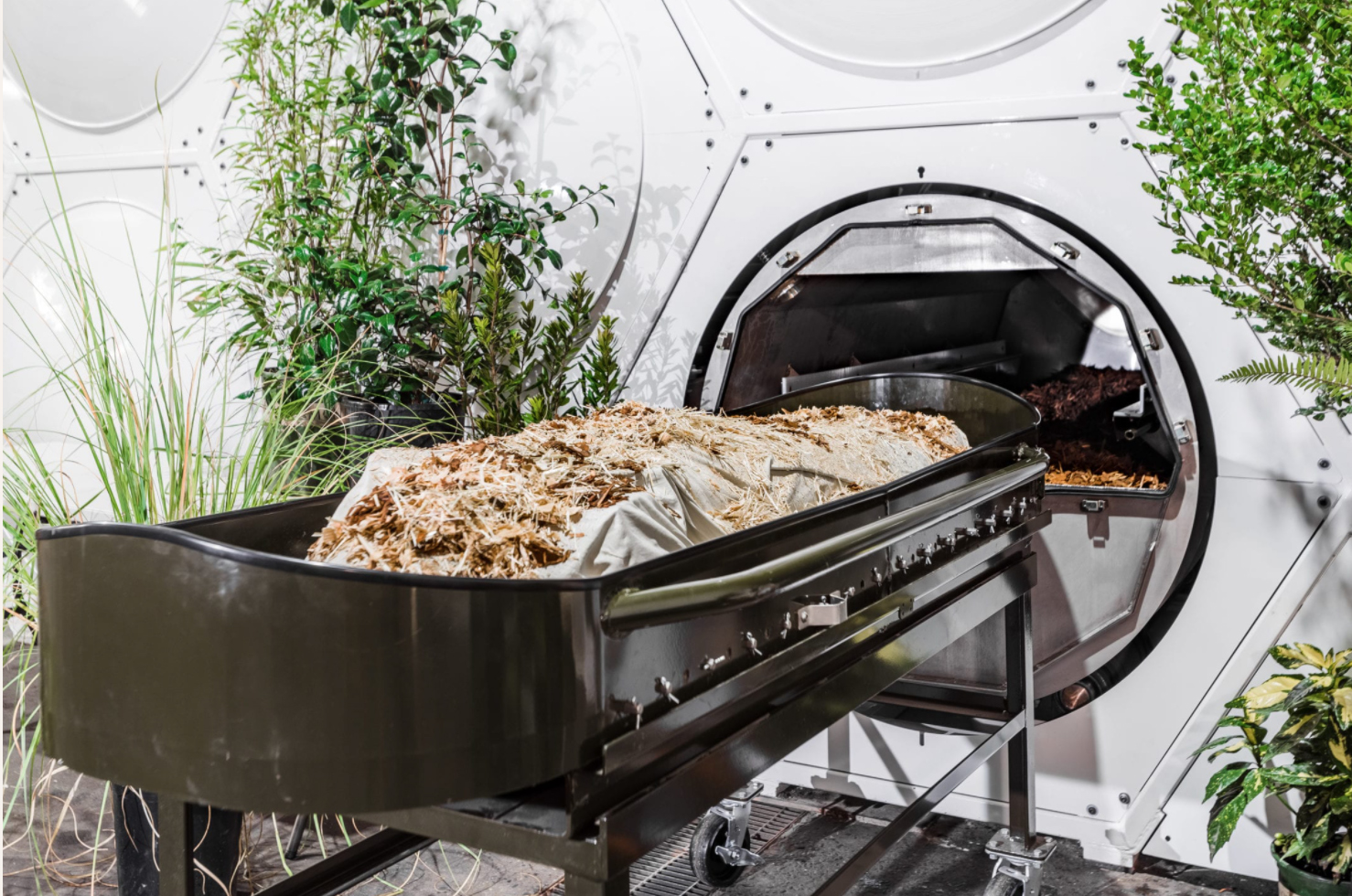
Photo courtesy of Recompose.
Human composting is rapidly gaining acceptance.
Only 43% of Americans Would Consider Choosing Embalming
When asked whether they would consider choosing embalming, which was defined for the survey respondent as “the process of injecting a dead human body with chemicals to temporarily slow down the natural decay of the body,” 43% of Americans said YES, and 57% of Americans said NO. That means that more than half of respondents wouldn’t even CONSIDER embalming.
In some ways, this preference is not a secret. From unpublished data, the actual embalming rate in the United States is believed to be less than 40%. But from the way the funeral industry is regulated and run, one would think that embalming is the beloved core of every American funeral. That may have been true in the 20th century, but it is not true anymore.
To understand why this is important, consider that the entire American funeral industry is regulated around the idea that every dead person will be embalmed- when less than half of Americans are embalmed or would even CONSIDER being embalmed. This assumption has some dire consequences: funeral homes pass along the cost of their investment in embalming education, equipment, and practitioners to consumers in the form of higher prices. People who want to serve families but don’t want to learn or practice embalming are discouraged or prevented from becoming funeral directors.
The preferences survey starkly demonstrates the significant gap between the way the funeral industry is regulated (as if every dead body will be embalmed) and the reality (that less than half the country wants to or will be embalmed.)
Human Composting is Rapidly Gaining Acceptance
Here is wildly fun part of the survey (keep in mind, the people surveyed were a cross-section of all Americans, not death acceptance enthusiasts).
When surveyed, not only had 44.8% of Americans heard of human composting, but 40.4% would consider choosing composting for their own dead body. These are pretty amazing numbers for a process that has only been around for about five years. And since those two numbers are so close together, it demonstrates that once someone hears and learns about the process, they are ready to consider it for their body as well.
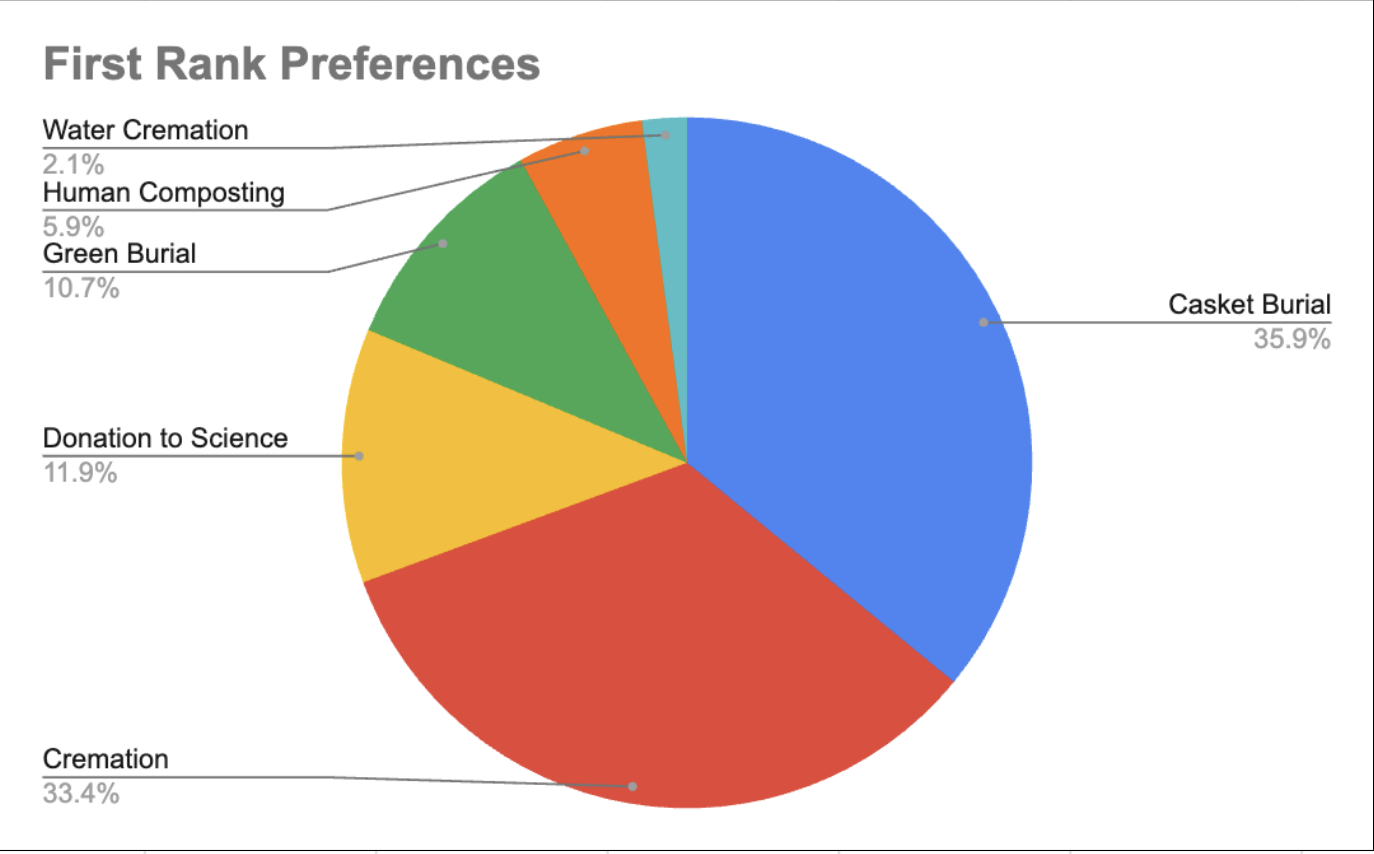
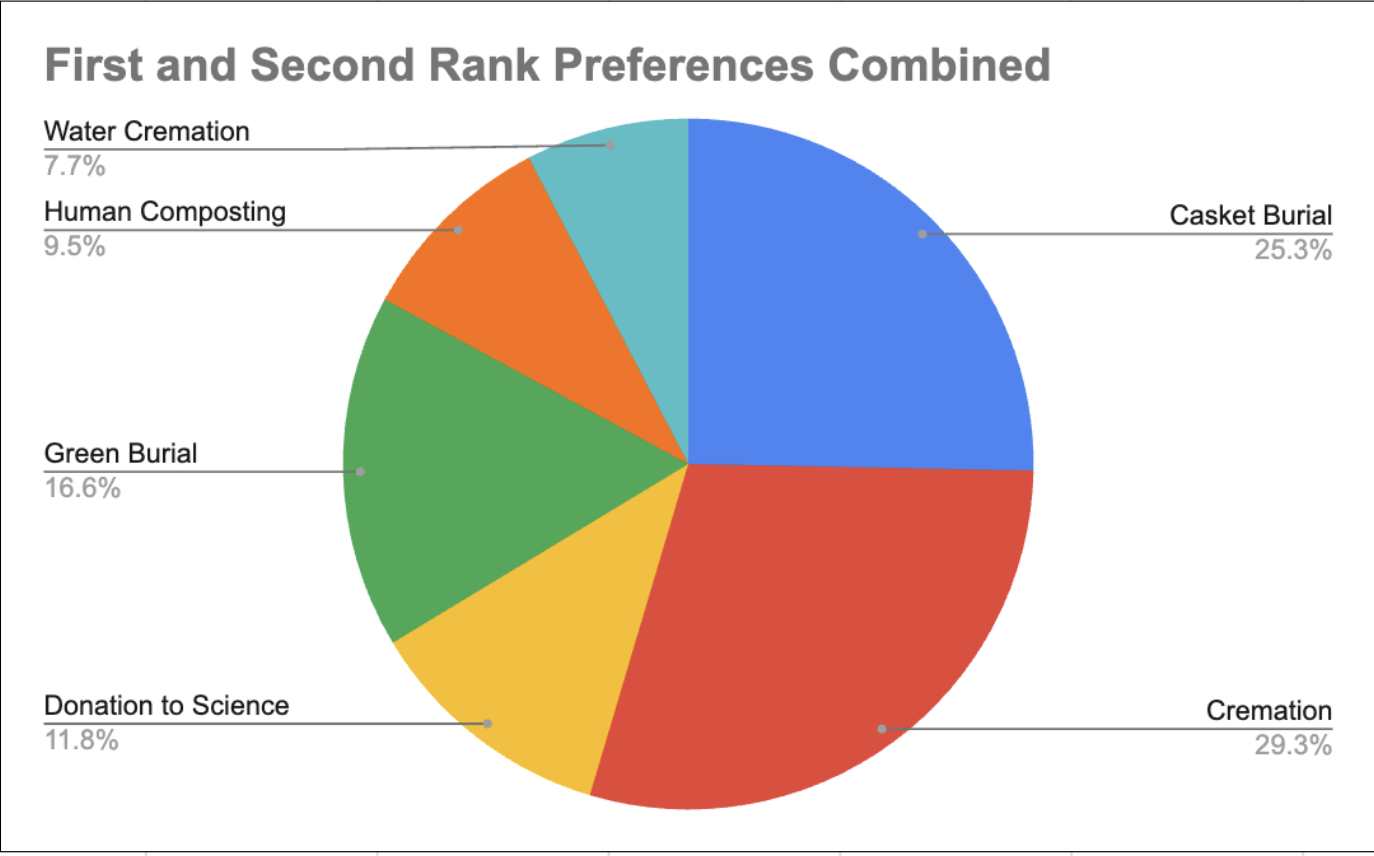
In a more specific ranked list of preferences, 6% ranked human composting as their first choice of disposition, and 19% ranked composting as their first or second choice. Our interpretation of that result is that composting’s lack of availability makes the process more of an aspirational dream than a concrete reality. (For now!)
Here’s why this matters. First, it shows that the work to introduce the public to human composting as a disposition method is working. What’s more, it’s working because something about the idea of our corpses becoming soil resonates with the public, with the highest acceptance numbers found in Millennial and Gen X respondents. The survey shows that composting also resonates in higher numbers with atheist and agnostic respondents, perhaps as an attempt to connect with a ritual and life-cycle in the absent of more traditional religious framework for their dead bodies.
Second, this survey result matters because it can affect policy. One of the goals of the survey was to provide reform advocates with data regarding consumer preferences. It is significantly more difficult for legislatures to treat human composting as a niche technology when confronted with data that shows the percentage of Americans willing to consider human composting (40.4%) is nearly the same as those willing to considering embalming (43.1%).
Finally, this survey result can impact the availability of human composting. The willingness to embrace human composting is even more amazing when you consider that although it has been legalized in 14 states it is really only practiced in three states (Washington, Colorado, and Nevada) today. For those in the industry thinking about making the significant investment to expand operations, this data shows there is unmet demand.
Way More People Are Being Cremated Than Want to be Cremated
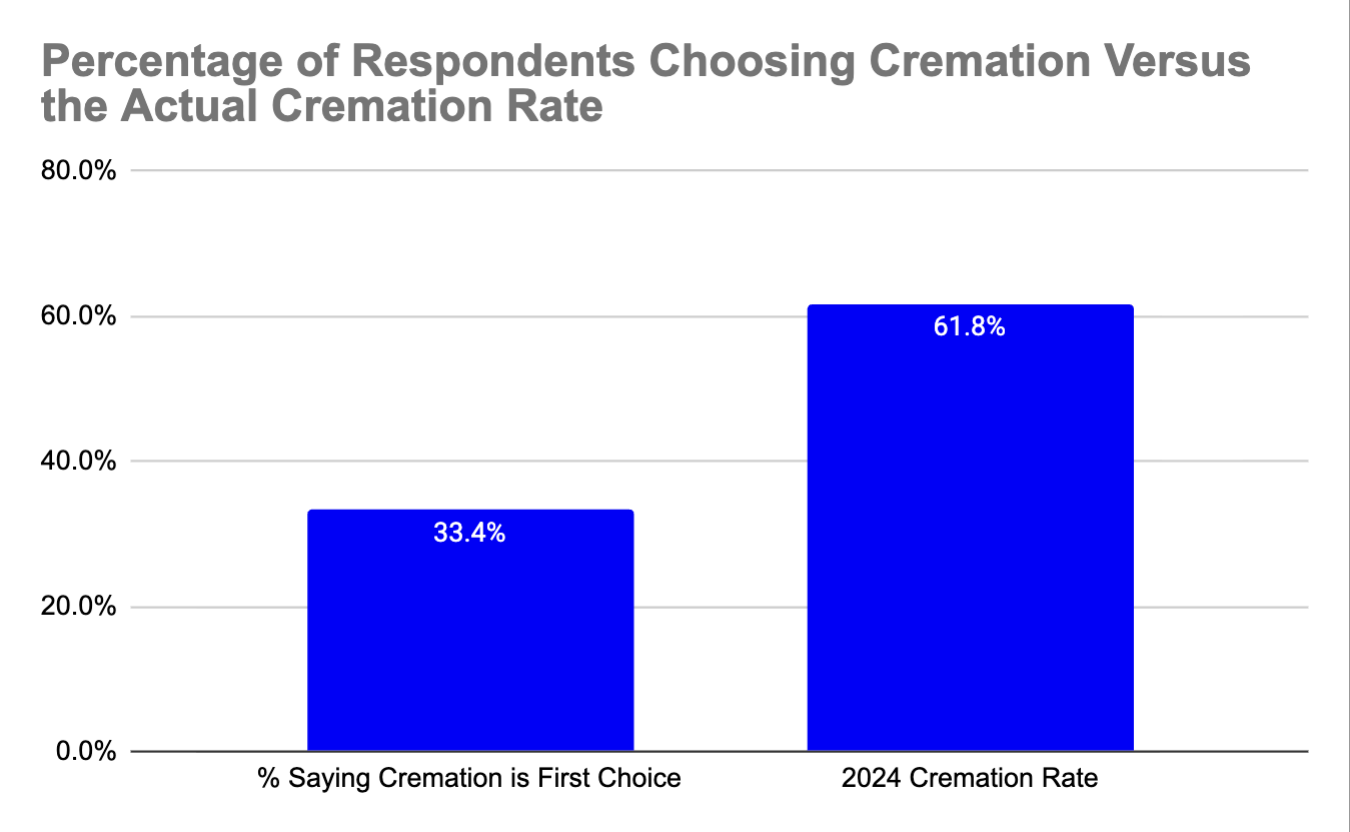
Data from the Cremation Association of North America tells us that 62% of Americans are currently being cremated. That number is rapidly rising, and expected to hit 75%. That’s the reality of how many people are being cremated each year.
However, if you ask people (as this survey did) what their first choice for their dead body is, only 33.4% of Americans say cremation. That is a pretty wide gap between desire and reality. The percentage of Americans who say that cremation is their first or second choice is nearly the same as the actual cremation rate. In other words, it seems like a lot of Americans are choosing cremation when it is actually their second choice.
Our interpretation of this data is that people are choosing cremation for price, easy availability, and easy mobility of cremated remains. People choose cremation because they don’t want the price, environmental impact and rigidity of so-called “traditional” burial.” It isn’t because they are particularly interested in cremation.
But if options like human composting, green burial, or even traditional casketed burial were more available and less expensive, that would be their top choice for their bodies. In some religions, such as Hinduism and Buddhism, cremation is considered a sacred process for the dead body. But in the United States, cremation may be American’s utilitarian option more than their heart’s desire.
There are many more gems found in the survey. To learn more, check out Episode 26 of Tanya Marsh’s podcast, Death et seq. and this summary written up in The Cremationist magazine.
Full results from the first iteration of the survey, completed in 2024 and funded in part by the Order, can be found in this article in the Wake Forest Law Review. Full results from the second iteration of the survey, completed in 2025, can be found in this white paper on the website of the Cremation Association of North America.
Because of your help, the Order of the Good Death can support, both financially and logistically, projects like this funeral survey. Our nonprofit continues to pursue projects that not only reflect changing values around death, but helps turn those values into better policy, better options, and a more meaningful, sustainable, and equitable deathcare system for all.
Your First Time Here? Find Out More About The Order!